How a Fast Website Improves Google Rankings and Increases Sales – JSV Tech Flux Pvt Ltd
By Admin
Feb 09, 2026
The Importance of Speed
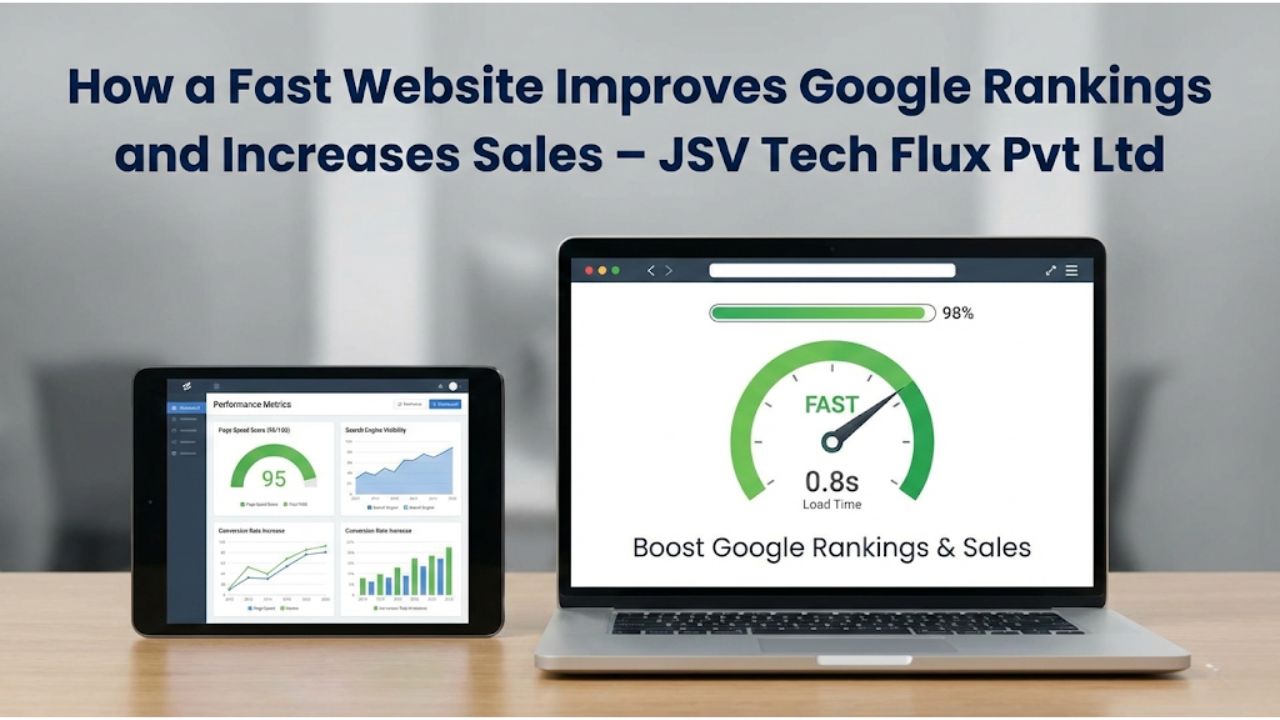
These days website speed isn’t only a technical issue, but it is also an indicator of business growth. If you offer services or sell products on an online store or are a B2B provider, your website’s speed will have a direct effect upon your Google search position, user confidence and sale conversion statistics.
In this blog, I am going to explain why website speed is so important, how it affects SEO and revenue, and what you can do to improve your website’s performance.
Why Speed is More Important
Today’s internet user expects websites to load in nearly real-time. Studies have shown that:
– Users will leave a website if it takes longer than 3 seconds to load.
– With each additional second of load time, your conversion rates drop significantly.
– Mobile users are even less forgiving about delays.
Using this information, Google has built a search engine that recognizes when users behave in this fashion and consequently rewards websites that load fast.
Website Speed & Google Rankings
1️⃣ Google Uses Speed as a Ranking Factor
Google officially measures website performance using Core Web Vitals, which are:
Largest Contentful Paint (LCP)
First Input Delay (FID)
Cumulative Layout Shift (CLS)
If you can perform well with your website in these metrics, you will be able to rank higher in the search engine results.
Websites with Quick Load Times Have Higher Levels of User Engagement
When your website has good page load speed:
- Users will spend more time on your site
- Your page views will go up for every visitor
- Your bounce rate will go down
These interaction metrics help Google understand your site adds value to users.
- Relying on Google Bots More Effectively to Crawl & Index Content
When your site has a good loading speed:
- Google can crawl more pages within their timeframe
- Google can index content faster for their databases
- Google can update your site's rankings in their organic search listings more frequently than your competitors
Loading speed of your website may directly influence your sales and lead generation.
- Create User Trust
Speed is perception driven. A fast website provides a sense of professionalism, trustworthiness and reliability to a user regarding higher valued products or services.
- Create High Conversion Rates
Fast-load times for web pages will:
- Increase your submission of online forms.
- Increase your number of click-to-call events.
- Enhance your online payment checkout completion (eCommerce).
Even a minimal increase in your website's load time can produce a significant increase in your revenue.
- Create Better User Experience with Mobile Devices
With the majority of Indians using their mobile device to surf the web, having a fast and optimal mobile website is essential. Users are more likely to abandon your site due to a slow mobile application.
Reasons Websites Experience Slow Load Times
Many websites are slow to respond to their respective visitors due to:
- Excessive or large images
- Poor web hosting service or infrastructure
- Large number of add-ons (plugins) and scripts
- Old or outdated coding/schema
- Lack of content optimization through caching or content delivery network
Not only do these elements create a frustrating user experience, but they also will negatively impact your SEO.
(Improving website speed) (actionable steps):
Optimize images
Use compressed formats and be sure about correct sizes before uploading any images; careful attention must be given so as to maintain picture quality.
Improve Hosting
Select a reliable and high-performance hosting service instead of selecting a cheap, shared-hosting provider.
Minimize Code
Remove any unused css/javascripts or other unneeded plugins and files.
Enable Caching & Use CDN’s
Enabling caching and utilizing third-party CDNs greatly reduces the loading speed of the web site for users in other geographic locations.
A high performance website (internal link to blog #1) focuses on these improvements at launch.
Speed + Design + SEO = Growth
Website speed will benefit from combining:
Clean,
Conversion oriented design (internal link to blog #3)
SEO-optimized structure
Mobile first design
By combining these factors you will help your website rank higher as well as generate more online sales.
JSV Tech Flux Pty Ltd. can assist our clients with improving their website’s performance rates and include site speed as part of an overall design and/or search engine optimization strategy, thereby helping to convert visitors into real business revenue.
Conclusion
A fast website results in a higher search rank and generates more revenue.
When competing in the digital marketplace, being fast on a website sometimes may mean the difference between gaining or losing a client to the competition.
Fixing slow sites should be a top priority for any company with an online presence.
A